When we talk about building educational games, we usually talk about pedagogy, design, and the craft of making learning feel like play. What we talk about less often is the quieter discipline behind all of it: staying current. The tools, platforms, and expectations around technology shift constantly, and a small team that wants to build something genuinely useful has to keep learning alongside the learners it designs for.
That is part of why we spent a week at Microsoft's AI Skills Fest 2026. And it is why, coming out of it, we've shipped our first public-facing set of MCP Server Tools, a direction we're genuinely excited about.
This post is about both: what we took away from the festival, what an MCP server actually is in plain terms, and what you can do with ours right now.
Why We Attended
AI Skills Fest is a free, week long virtual experience aimed at exactly the kind of practical, role-based upskilling that small teams rarely make time for. Rather than abstract theory, it focuses on how AI fits into the work people are already doing; with live virtual sessions, hands-on tracks, and a hackathon centred on building agents.
A great deal of the conversation across the week kept returning to the same idea: increasingly, the software people use is not just operated by humans clicking buttons, but by AI agents acting on their behalf. If you want your product to be useful in that world, it has to be able to talk to those agents. We left the event with a clear next step, and we built it.
So, What Is an MCP Server?
MCP stands for Model Context Protocol. It is, essentially, a shared language that lets AI agents connect to outside services in a safe, structured way. Think of it as a set of doors we can open into our own catalogue; doors that an AI assistant can knock on and ask sensible questions through.
Without something like this, an AI agent only knows what it happens to have read about us somewhere on the internet, which may be outdated, incomplete, or simply wrong. With an MCP server, the assistant can ask us directly and get a live, accurate answer straight from the source.
We are beginning to build public facing agentic tools that let other software understand and recommend our games on a parent's or educator's behalf.
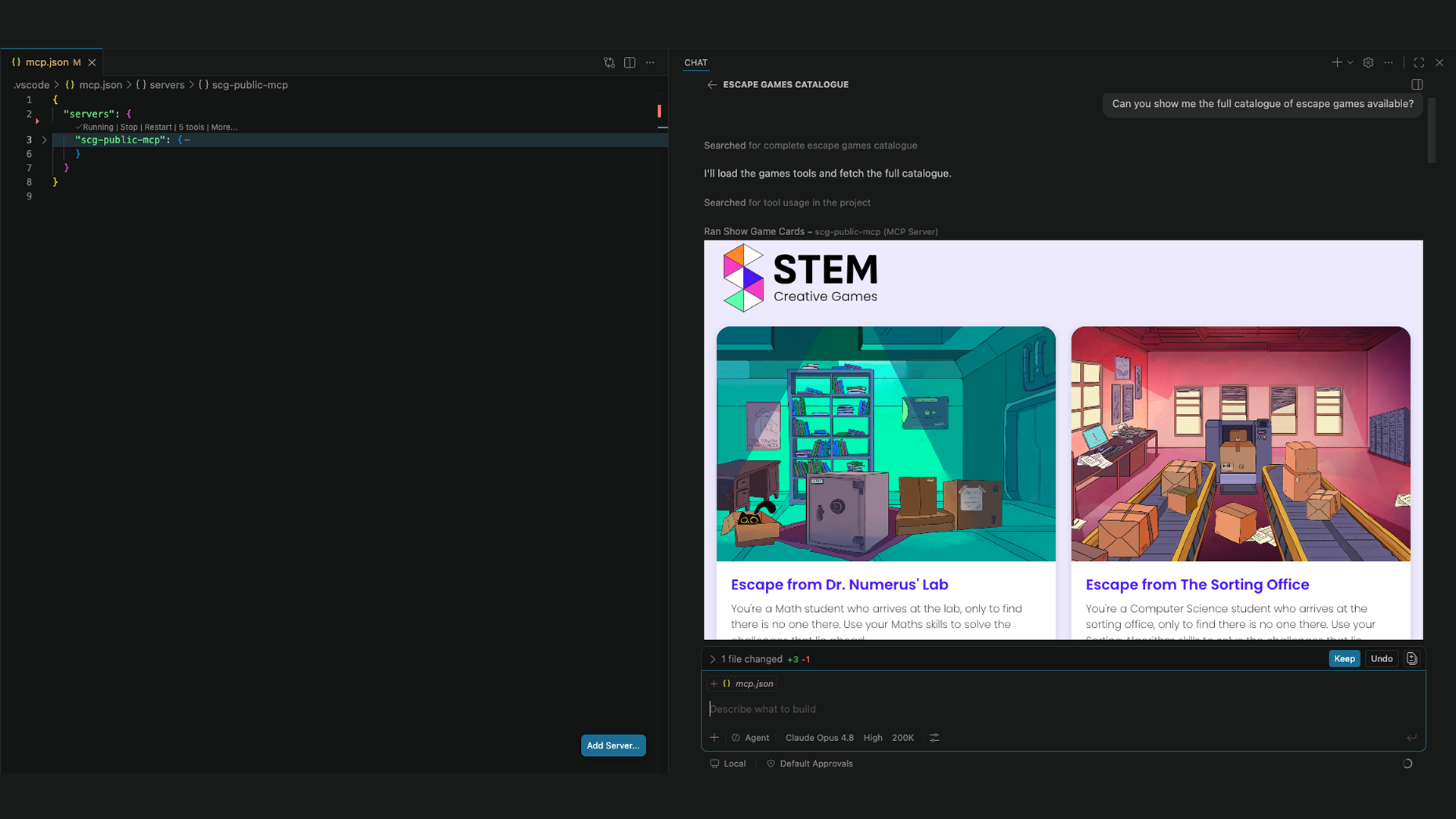
Before any of our tools reached the public, they were tested. The screenshot below shows our first test harness for MCP tools: the server running in VSCode, connected to an AI assistant, with every tool exercised and every response verified against its expected output. This step is deliberate. We would not place a game in front of a classroom without rigorous testing, and we hold the tools that support those games to the same standard. Reliability is a requirement we design for from the outset.
What This Looks Like In Practice
Our first public facing MCP server is deliberately focused. It does one thing well: it lets an AI agent explore our game catalogue intelligently. Specifically, it can do three things.
- It can list every published game we offer, with its subject, age and grade range, and a description.
- It can pull full details on any single game, including its topics, learning outcomes, key concepts, and duration.
- And it can search the catalogue by subject, grade level, age, or free text; so a question can be as specific as the person asking it.
Here is what that means for a real person. Imagine a parent of a ten-year-old, using an AI assistant connected to our server. They can simply ask: "Find me a maths escape room suitable for a 10 year old, and tell me what it actually teaches."
The agent queries our catalogue live, finds Escape from Dr. Numerus' Lab , and can explain that it covers number and place value, rounding, and multi-step problem-solving for Key Stage 2; all mapped to the curriculum, all in a single 60-minute adventure.
A teacher might come at it differently: "What computer science games do you have for Key Stage 3, and which algorithms do they cover?" The assistant can point them to Escape from The Sorting Office and describe how it puts Binary Search, Bubble Sort, Merge Sort, and Insertion Sort into the hands of learners as something to apply, not memorise.
These two titles are live and searchable today. Two more, an art-and-colour-theory game and a chemistry game built around the periodic table, are on the way and will surface through the same tools the moment they're published. No new integration required; the tools are synced with our live catalogue.
We've Laid The Foundation
The release of our first public facing MCP tools, is a discovery layer. It helps the right game reach the right learner through whatever assistant a parent or educator already trusts. That is genuinely useful, but it is also the beginning.
What it lays the groundwork for is far more interesting.
TARISAI GUNDU
The same approach that lets an agent or assistant find our games can eventually let it help an educator assign them, track progress across a class, or recommend a next game based on where a particular learner is struggling. The plumbing we've just put in place is the thing that makes those educator and parent facing tools possible.
In other words, we didn't build this because MCP is a buzzword. We built it because it is the most direct route to the tools we actually want to put in the hands of educators and parents next.
Trying It Yourself
Connecting to our tools takes one small extra step today, and we think it's worth it. Our MCP server is live right now, and any AI assistant that supports custom connectors; Claude and ChatGPT among them, can be pointed straight at it using our server URL. You'll find that URL in your account dashboard once you've signed in. Add it as a custom connector, and your assistant can begin exploring our catalogue straight away.
We're also in the process of submitting to the Claude and ChatGPT connector directories, so that before long this becomes a one-click affair with no URL to copy at all. But there's no need to wait for that. The door is already open for anyone who'd like to walk through it today.
Keeping Pace, On Purpose
The whole premise of our game platform is that curiosity, experimentation, and a willingness to be a beginner again are what real learning looks like. It would be a strange thing to ask that of students and not of ourselves.
AI Skills Fest was a reminder that keeping pace isn't a distraction from the work; it is the work. We came away with new skills, a clearer sense of where things are heading, and one concrete piece of software built and shipped.
If you'd like to be among the first to try our games, you can join the beta. And if you share our curiosity about where all this is heading, stay close; this is only the first of the tools we're building, and there is a great deal more to come.